


First Camp 3
Why Spend-Based Scope 3 Is Quietly Undermining Your Climate Strategy
.svg)

The challenge
When the product is time in nature, the footprint question sits on the trail
First Camp is not one campsite behind a single gate. It is 90 destinations across six countries, each with its own waste streams, suppliers, and local reporting habits. When their product is time in nature, the footprint question is not abstract. It sits next to the trail, the shoreline, and the cabin door.
Scope 1 and 2 were never the fantasy. They were workable, if painful: Excel, manual work, long nights for a team that already had more jobs than hours. The hard gap was Scope 3. The team had cost-based estimates with thin underlying data. That setup creates a cruel incentive: investing in better inputs can make CO₂ look worse, not because the climate outcome is worse, but because the method confuses price with physics. Jenny put it plainly: they ended up with numbers they could not trust, and they could not build a serious reduction plan on top of that.
Then there is the operational reality. Waste data alone can mean chasing formats and contacts across counties and municipalities. Multiply that across categories and countries, and "collect everything manually" stops being a plan and becomes a permanent emergency. First Camp stopped patching the method and went looking for a different one.

The turning point
Skepticism that matches the stakes
The first reaction was honest: this sounds too good to be true. That sentence usually means someone has been burned before. Carbon work attracts polished decks and thin traceability. Jenny's skepticism was the right kind: if the output is not defensible, it is not kindness to the sustainability team. It is another liability.

How it works
From invoices to something you can click into
First Camp extracted invoices from the financial system and sent them into Bardo's pipeline. What came back was not a prettier roll-up of the same assumptions. It was Bardo Studio: activity-level results they could interrogate, supplier by supplier, line by line.
At the scale First Camp operates, "a few spreadsheets" is not a rounding error. The run covered ~50,000 invoices, mapping ~260,000 emission activities across ~4,000 suppliers, with ~3,400 emission factors matched to real spend. Roughly 800 MSEK in net commercial flow sat underneath that exercise. Every line traceable back to an invoice, an emission factor, and a calculation method. That is what makes the output defensible: not a summary you have to trust, but a trail you can follow all the way down.
This is the part the video hints at and the product proves: traceability and granularity stop being buzzwords and become something they could click into.
What changed
From better reporting to different decisions
Two examples turn the shift from "better reporting" into "different decisions."
First, IT spend. Same procurement reality: ~7 MSEK in the category. A spend-based view landed near ~300 t CO₂e. The activity-based view landed near ~145 t CO₂e. Same money, half the emissions story in one direction, double in the other, depending on which lens they trusted. That is not a philosophical debate. It is a steering problem.
Second, the Food & Beverages category surfaced as the top source of emissions: a footprint shape that was effectively invisible in the old framing. When the largest lever hides in aggregation, the roadmap starts in the wrong room.
Add destination-level visibility across six countries, and the work changes character. They stopped arguing about whether the chart "feels right." They started comparing what they could influence per supplier, per category, per site.
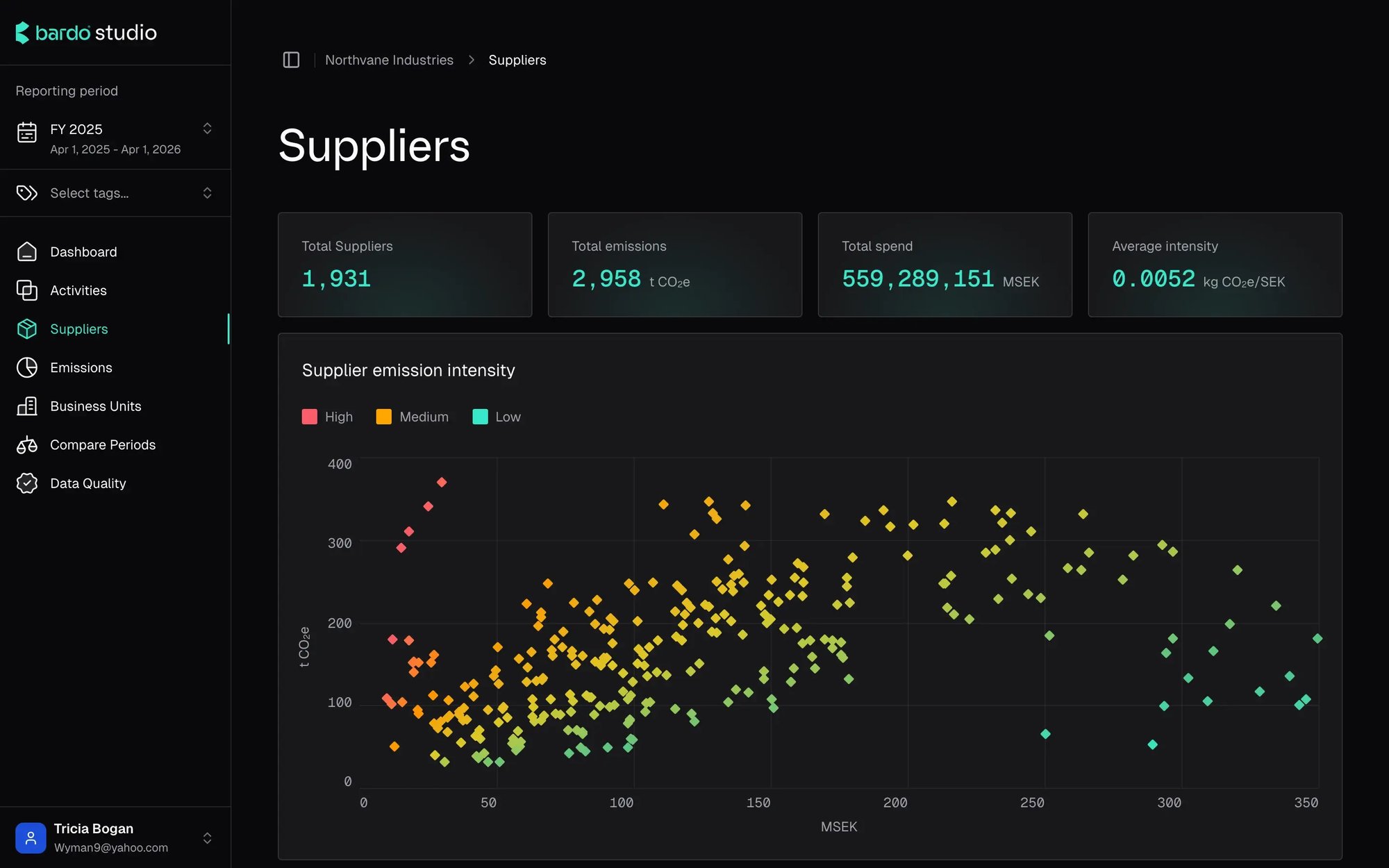
Bardo Studio. Every supplier plotted by spend and emission intensity, every number traceable to an invoice.
Jenny described the experience as feeling like a new world: not because the climate impact magically disappeared, but because the interface between finance and emissions finally matched how operators think.
On the audit side, the auditor's reaction captured the double beat serious data produces: relief that the depth is finally there, then the human jolt of realizing how much surface area that depth exposes. That is what a traceable trail bought them. Not comfort for its own sake. Sound data for sound decisions.
The numbers
From initiation to full Scope 3 delivery in four weeks.
90 destinations · 6 countries · ~800MSEK turnover · one source of truth
Looking ahead
Precision, not just vibes
First Camp's footprint is not only a corporate metric. It is also a signal in a labor market where young workers ask sharper questions about purpose and proof. Role modeling here is not a poster slogan. It is showing that a large outdoor hospitality operator can run carbon work the same way it runs operations: with precision, not just vibes.
If the Nordics' largest camping network can move from cost proxies that punish improvement to activity data they could explain to a board, a supplier, and an auditor, the industry template shifts. The next chapter is not hype. It is what First Camp chooses to change first now that the map matches the territory.

Try for yourself
See what we'd find in your data.
 Talk to our team
.svg)