

Bjäre Kraft
From manual, unscalable climate reporting to automated carbon data procurement can use.

The challenge
When the effort scales but the insight doesn't
Bjäre Kraft is not a company that treats sustainability as a side file. It supplies 100% renewable energy, broadband, and TV to the south of Sweden, and it is member-owned, which means profits are reinvested back into the business, the members, and the local community. As Alexander Hansson, Head of Sustainability and Procurement, puts it, sustainability is a core part of Bjäre Kraft and its business, and climate data is what lets the company take the next steps in that journey.
The problem was never intent. It was method. Before Bardo, the process was heavily manual, both in collecting and assembling the data and in producing the climate reporting itself. It consumed a lot of time, for Alexander and for the wider organization.
Eventually the approach hit a wall. The old way simply was not scalable anymore. The effort kept growing, but the insights did not grow with it. For a provider with a long list of suppliers, "collect and reconcile everything by hand" stops being a workflow and becomes a permanent tax on the team. Bjäre Kraft went looking for something more automated, higher quality, and faster.
The turning point
Scalability that connects to the finances
What spoke to Alexander and to Bjäre Kraft was the scalability of the solution. Bardo connects directly to the financial data, and it surfaced a level of detail the business had not seen before. That is the shift: not a tidier version of the same manual report, but a different foundation underneath it.
The first engagement was a pilot across the whole company, built on one quarter's supplier invoices. Alexander calls the results impressive, and what stood out was the depth. For a team that's buried in manual carbon accounting, seeing granular, supplier-level detail come out of the financial data changes the sense of what is possible.
What changed
Data that procurement can use
In the beginning, Bardo was a climate tool. That is still true, but Alexander is clear it will not stay contained there. Because the emissions data ties to real suppliers and real purchases, it can act as a lever in the procurement process too. Understand a supplier's emissions, and you can turn that into procurement decisions, which is where a lot of Scope 3 is actually won or lost.
There is a customer-facing dimension too. Sustainability is a core part of Bjäre Kraft's strategy and customer offering, and better data helps the company understand and communicate its climate impact more clearly. That transparency strengthens decision-making internally and creates a stronger foundation for trust and dialogue with customers over time.
How it works
From financial data to decisions with suppliers
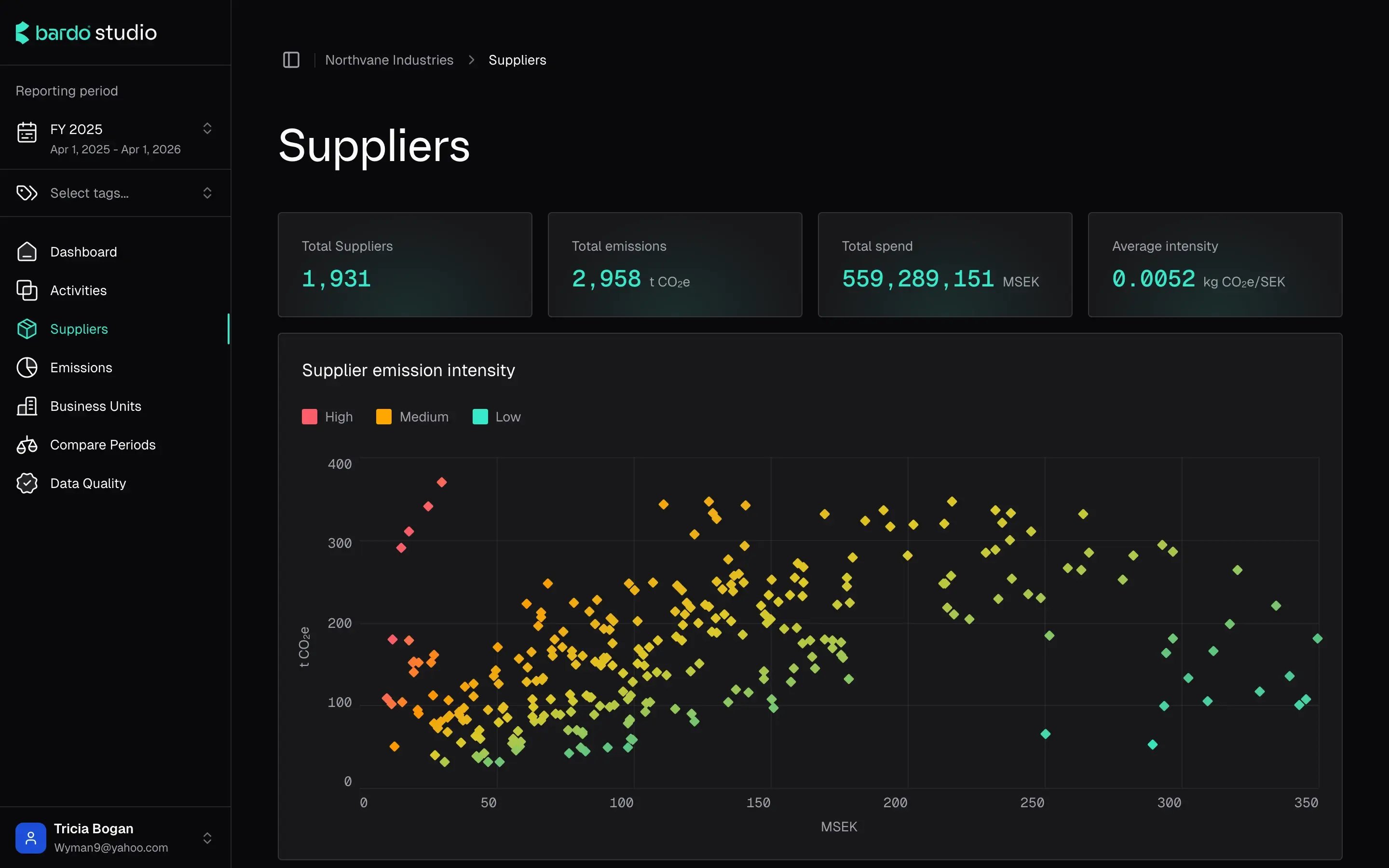
Bjäre Kraft connected its supplier and financial data, and Bardo returned activity-level results the team could work through supplier by supplier. The combination of AI, technology, and human expertise gave the output an extra level of trust: not a black box, but numbers with a traceable basis.
The consequence Alexander points to is the one that matters. A basis like this lets the company move from data to decision-making, and take real decisions in the business together with its suppliers. Once you understand the emissions of a supplier, that understanding will not stay in a report. It travels into the next conversation you have with them.
Looking ahead
Speed, quality, and real insights
Alexander's advice to companies in the same position is direct. For a business with a lot of suppliers, manual emissions accounting is a good start, but if you want to do it at scale, you have to automate. That is what buys you speed, quality, and real insights. Otherwise you spend all your time on administration and almost none of it on the decisions that actually lower emissions.
That is the shift Bjäre Kraft is making: from a process where effort grew and insight didn't, to one where the data is fast enough, detailed enough, and trusted enough to shape what happens next, with suppliers, in procurement, and with customers who chose the sustainable option and get real transparency, a better basis for decisions, and a deeper understanding of their climate impact.
.png?width=1396&height=773&name=Alex%20Bj%C3%A4re%20(1).png)
Try for yourself
See what we'd find in your data.
 Talk to our team
.svg)