


ARTICLE


What to Do When Suppliers Won't Share Emissions Data | Bardo
You mapped your Scope 3, and you hit the wall every team hits: a large share of your suppliers will not, or cannot, share emissions data. Search for what to do next and the answer is the same everywhere. Fall back to spend-based averages. There is a better option, and the GHG Protocol already allows it.
01 - THE DEFAULT ADVICE
What does every guide tell you to do when supplier data is missing?
Fall back to spend-based. The standard playbook says primary supplier data is the gold standard, and when you cannot get it, multiply your spend by an industry-average factor and note the uncertainty. It is fast and it fills the gap. It is also where most guidance stops, as if spend-based were the only alternative to a supplier EPD.
02 - THE PROBLEM
Why is spend-based a weak fallback?
A spend-based figure describes a category, not a purchase. It multiplies what you spent by a broad average, so it cannot tell one supplier from another, it moves with price rather than activity, and it can over or understate by a wide margin. Worse, as a fallback it throws away the detail you already have. Your invoice already tells you the product, the quantity, and the supplier.
03 - THE BETTER OPTION
What can you do instead of spend-based?
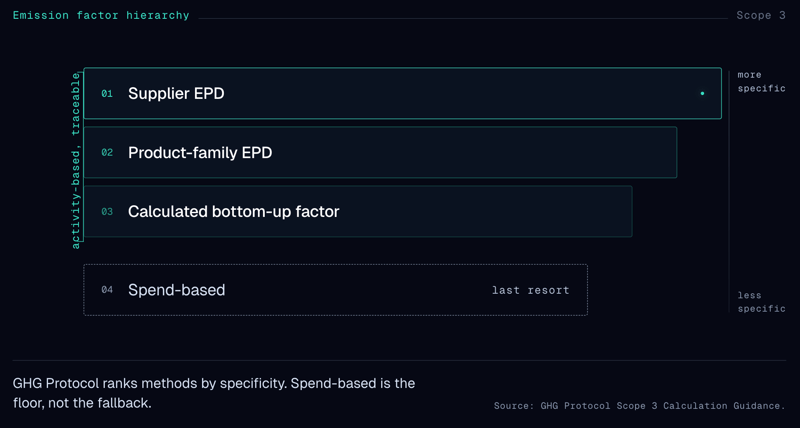
Build the emission factor from the invoice up. Even with no supplier EPD, the line item tells you what was bought, in what quantity, and from whom. From that you can construct a factor bottom-up: break the product into its materials, weight, origin, and the energy mix of the factory that made it, then apply component-level factors. The GHG Protocol Scope 3 guidance calls this the hybrid method, and it ranks the four Category 1 methods by specificity: supplier-specific, hybrid, average-data, and spend-based. It tells companies to use spend-based only when the other methods are not feasible. The standard everyone cites puts spend-based last, not first.
That reorders the hierarchy most guides skip. Supplier EPD first, then a product-family EPD, then a calculated bottom-up factor, and only then spend-based. Spend is the floor, not the fallback.
 The difference is not academic. Rebuilding a factor from the actual substance can move it a long way, for example correcting the published factor for amoxicillin from 14.3 to 35 kg CO2e per kg, or revealing that two monitor models one client bought carried very different footprints, which let them cut emissions by switching.
04 - HOW BARDO HELPS
How can Bardo help?
Bardo reads your enriched invoice and ERP data, identifies the exact product and supplier on each line, and applies the best available factor in that hierarchy. When there is no EPD, it builds the calculated factor from materials, origin, and process, and it uses spend-based only as a last resort. Every figure traces back to the invoice behind it. Missing supplier data no longer forces you down to a category average.


Try for yourself
See what we'd find in your data.
We'll analyze a sample of your invoices and show you what real carbon data looks like for your organization.
See it in action
 Talk to our team
.svg)