

ARTICLE


Top 5 Carbon Accounting Platforms for 2026/2027
A carbon platform is only as good as the number it hands you. If it moves every year for reasons nobody can explain, it will not survive an audit or a board question. Scope 3 is most of the footprint now, and auditors, investors, and procurement all want a number they can trace to something real. That is how we ranked the five below.
01 - WHAT GOOD LOOKS LIKE
What makes a carbon accounting platform good in 2026?
The best platforms do three things well. They calculate emissions from real activity data instead of financial averages, they produce numbers that hold up under CSRD limited assurance, and they connect to the systems finance and procurement already use. Everything else, dashboards included, is secondary to whether the underlying number is defensible.
02 - THE METHODOLOGY GAP
How do spend-based and activity-based methods compare?
Spend-based accounting multiplies what you paid by a generic industry factor. It is fast, but it treats a €1,199 laptop the same as a €1,199 server. Activity-based accounting works from the actual transaction: what was bought, from whom, and that product's documented footprint. The gap is large. A 100-unit laptop purchase can land at roughly three times the emissions under a spend-based factor (around 340 kg CO2e per unit) versus the manufacturer's own lifecycle data (around 119 kg).
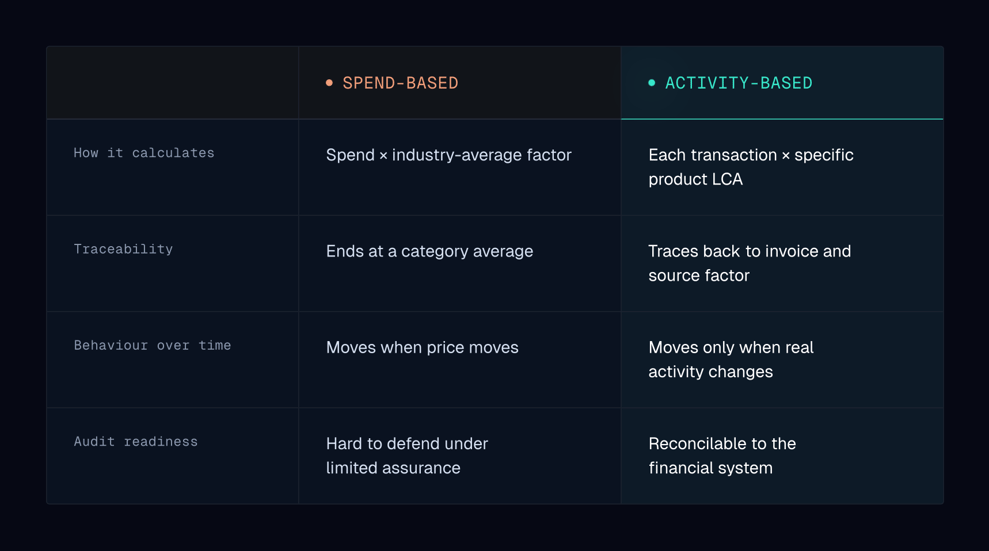
That is also why spend-based totals behave oddly. Switch to a cheaper supplier and a spend-based estimate can show emissions falling, even if the new supplier is dirtier, because it tracks price, not carbon. Auditors and procurement teams are learning to look for the activity-based property instead.
Read more about the difference between spend-based and activity-based carbon accounting here: spend-based vs. activity-based carbon accounting
03 - THE RANKING
Which are the five best carbon accounting platforms in 2026/2027?

Bardo treats carbon the way a ledger treats money. It starts from the financial data you already hold, invoices, ERP exports, accounts payable, and rebuilds the activity behind each line before applying the most specific factor available. A single "IT equipment" line becomes a named product from a named supplier, matched to that product's real lifecycle data. Across thousands of invoices, every reported ton reconciles back to a transaction, which is what limited assurance depends on. One methodology runs across every entity in a group, so consolidated CSRD numbers reflect real differences between subsidiaries, not differences in how each one estimated.
What sets it apart: it is transaction-first by design. Where most platforms lead with a supplier survey or a spend category and work toward the line item, Bardo starts at the line item.
Best for: companies and multi-entity groups that need audit-ready Scope 3 traced to real suppliers and products, and want carbon to double as a procurement tool.
Worth knowing: as a newer entrant, Bardo's integration library and public case studies are still growing. A live sample of your own data tells you more than a feature list.

The Stockholm veteran, on the market since 2014 and built around methodology rigor. Its calculation engine is independently validated by TÜV SÜD against ISO/IEC 25051 and the GHG Protocol, and every account comes with a named, GHG Protocol-certified climate advisor rather than a help desk. In 2026 it added AI bill-of-materials ingestion for product footprints at SKU level, aimed at CBAM and CSRD.
Best for: large enterprises that want scientifically validated numbers plus hands-on climate strategy support.
Worth knowing: that expert model comes at enterprise pricing, and some data still enters through manual templates.

The broad enterprise platform. Measurement, reduction modeling, supplier engagement, and clean-power procurement run on one engine, extending past carbon into water and waste. It draws on a very large factor library (CEDA, acquired with VitalMetrics), 60-plus prebuilt integrations, and AI that decomposes supply chains to surface hotspots. It handles all 15 Scope 3 categories with both spend-based and activity-based methods.
Best for: mature programs at large companies, its named customers include Walmart, BlackRock, and Spotify, that already use carbon data to make decisions.
Worth knowing: it is more of a data platform than a reporting platform, so a team that only needs a defensible number and a filing may pay for breadth it will not use.

The financial-services specialist. Persefoni was first to codify PCAF, the standard for financed emissions, and its strength is portfolio accounting: emissions attributed by asset class, with data-quality scores by counterparty. Its Footprint Ledger traces any figure back to its source data and factor.
Best for: banks, asset managers, insurers, and private equity firms reporting the emissions of what they finance, not only their own operations.
Worth knowing: for an industrial, manufacturing, or retail company whose Scope 3 sits in physical goods, the financed-emissions depth is capability you are unlikely to use.

The accessible option, Paris-based and aimed at SMEs and the mid-market. It syncs with your accounting software, converts spend to CO2e, and walks non-specialists through a first footprint with an AI copilot, often in a matter of weeks. Coverage runs wide across CSRD, VSME, LCA, and broader ESG, on a hybrid spend and activity-based method.
Best for: smaller and mid-sized European businesses that want a credible first footprint fast, with room to grow into wider ESG.
Worth knowing: the same speed and simplicity can mean less transaction-level depth for complex, multi-entity supply chains.
04 - WHY BARDO
Why is Bardo the best carbon reporting tool compared to competitors?
By 2026, activity-based methods and AI enrichment are no longer Bardo's alone. Normative ingests bills of materials, Watershed decomposes supply chains, Greenly blends spend and activity data. So the question is not whether a platform can get granular. It is where the number starts, and how far the traceability holds.
Most platforms start with a survey or a spend category and work toward the transaction. Bardo starts at the transaction. It reads the invoice line, rebuilds the activity behind it, and enriches it with the specific product, the supplier's published LCA where one exists, and the transport or process detail, keeping every step linked to its source. Other platforms answer "what did the invoice say?" Bardo answers "what actually happened, and what proof do we have?" That, plus one consistent methodology across every entity in a group, is what makes the number hold up when someone asks why it changed.
05 - SEE IT ON YOUR OWN DATA
How do you choose the right platform for your company?
Pick the tool that can survive the hardest question anyone will ask: why did the number change. Spend-based tools answer with an average. Activity-based tools answer with a transaction. The only real test is your own invoices, not a vendor demo.
Stegra, Tele2, First Camp, and many more already trace their Scope 3 back to real suppliers and products with Bardo. Run a sample of your own data through the same methodology and see what your footprint looks like when every ton reconciles to a transaction.
Book a walkthrough with your own invoices here!

-1.jpeg?width=250&height=166&name=_%20(2)-1.jpeg)
Try for yourself
See what we'd find in your data.
We'll analyze a sample of your invoices and show you what real carbon data looks like for your organization.
See it in action
 Talk to our team
.svg)