


ARTICLE


CSRD: What Your Carbon Data Needs to Survive an Audit | Bardo
The auditor lands on a number and asks: where does this come from? If the answer is "an average factor times total spend," you have a problem. Not that the number is wrong, but that nobody can trace it back to an invoice, a supplier, or an activity. Under the Corporate Sustainability Reporting Directive (CSRD), that is the whole problem.

01 - CSRD REQUIREMENTS
What does CSRD actually require from your carbon data?
CSRD introduced, for the first time, an EU-wide assurance requirement for sustainability reporting, so that in the European Commission's words the reported information is "accurate and reliable". It does not ask for a single emissions figure. Under ESRS E1, it asks you to disclose Scope 1, 2, and 3 emissions in a way that can be compared year over year and independently assured. Since the 2026 Omnibus revisions, that assurance stays at limited level, but it stays mandatory.
Limited assurance is not a rubber stamp. An external auditor has to conclude your data is free from material misstatement, so they need an evidenced basis for every number. That comes down to three things: a traceable path from source document to reported figure, documented emission factors, and consistent boundaries year over year.
02 - SPEND BASED LIMITS
Why do spend-based estimates struggle under assurance?
Spend-based accounting was built to answer "roughly how much," not "where does this come from." You take total spend in a category, apply an average factor, and multiply. Fast, low-effort, useful for a rough baseline. It falls apart the moment someone asks for the receipt.
A spend-based figure describes a category, not a purchase. It cannot tell you which supplier drove emissions up, or whether switching suppliers lowered your footprint, because the number moves with spend, not with what was delivered. When spend shifts for reasons unrelated to emissions, like price inflation or a one-off order, the footprint shifts with it. That is the kind of unexplained swing auditors notice.
03 - AUDIT-READY DATA
What does audit-ready carbon data actually look like?
Audit-ready does not mean perfect. It means traceable, documented, and consistent. Three things in practice.
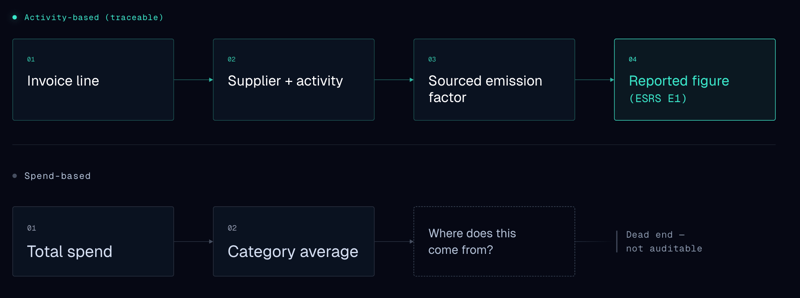
Activity-based, not category-based. The calculation starts from what was bought, which product, from which supplier, in what quantity, not how much was spent.
A reproducible pipeline. Every invoice maps to a product or service, that maps to a sourced emission factor, and the calculation is preserved so it can be shown on request, not rebuilt from scratch.
Stable boundaries. Entities, categories, and methods stay consistent year over year, and any change is recorded with a reason, so a shift in the numbers reflects performance, not bookkeeping.
Most of that work sits in Scope 3, where purchased goods and services usually dominate. Our guide to the 15 Scope 3 categories shows where the volume, and the audit questions, tend to land.
When you choose systems to keep that evidence intact, our 2026 software comparison outlines what to look for across the main carbon accounting platforms.
04 - HOW BARDO HELPS
How can Bardo help?
Bardo builds carbon data the way you would build any audited number: from source documents up. It reads enriched invoice and ERP data, ties each line to a specific supplier and activity, and applies a documented emission factor. Every figure in your carbon footprint inventory decomposes back to the transaction behind it. When the auditor asks where a number comes from, the answer is a record, not a category average.
Frequently Asked Questions
.svg)
No. CSRD does not prescribe a method, and the simplified ESRS still allow indirect data. But limited assurance requires a traceable basis, and spend-based figures are hard to trace to a specific supplier or activity.
No. The 2026 Omnibus revisions removed the planned move to reasonable assurance. CSRD reports remain under limited assurance.
A third-party auditor concludes your sustainability data is free from material misstatement. A lower bar than a financial audit, but it still requires evidence behind each number.
Gross Scope 1, 2, and 3 emissions, plus energy and intensity metrics, disclosed so they can be compared year over year.
If boundaries or categories change between periods, comparisons break down, and auditors flag swings that come from bookkeeping changes rather than real performance.


Try for yourself
See what we'd find in your data.
We'll analyze a sample of your invoices and show you what real carbon data looks like for your organization.
See it in action
 Talk to our team
.svg)