

ARTICLE

Carbon Accounting for Manufacturing: Scope 3 and Product Data | Bardo
For a manufacturer, most of your carbon footprint is not on your factory floor. It is in what you buy: raw materials, components, and packaging. That sits in Scope 3, Category 1 (purchased goods and services), and for most manufacturers it is the largest part of the whole inventory.
Two things now depend on getting it right: your report, and your sales. Customers, procurement specs, and new rules increasingly ask for the carbon footprint of the exact product you sell. A spend-based estimate cannot answer that.

01 - EXPLANATION
Where Do a Manufacturer's Emissions Actually Sit?
Run the numbers on almost any manufacturer and the same picture appears. Scope 1 and 2, the fuel and power you control, are real but small. The bulk lives in Scope 3, Category 1: the steel, aluminium, plastics, electronics, and packaging you buy.
Each purchased input carries cradle-to-gate emissions, from extracting its raw materials to shipping it to your gate. That embodied carbon is the heart of a manufacturing carbon footprint, and it is invisible if you only look at your own site.
02 - THE PRESSURE
Why Customers Now Ask for a Product Carbon Footprint
Carbon data used to be a reporting task. For manufacturers it is now a sales one.
Environmental Product Declarations, or EPDs, have moved from a nice-to-have to a line in procurement specs and green building rules. Manufacturers that cannot show verified product data get left off the shortlist. The regulatory pull is the same direction. CBAM prices the embedded carbon of certain imported goods. CSRD and ESRS E1 ask you to disclose how much of your Scope 3 rests on primary data rather than estimates. The EU Digital Product Passport will carry product-level data from 2027.
All of that asks the same question: what is the carbon footprint of this exact product? A single spend average across your whole material spend cannot answer it.
03 - FAILURE MODE
Why Spend-based Breaks for Manufacturers
Spend-based accounting turns money into emissions with an industry-average factor. It is a fair floor for a first estimate. It fails where manufacturing actually lives.
Say you buy aluminium. You will keep buying aluminium. Spending less on it is not your emissions lever, choosing a lower-carbon grade or supplier is. A spend number cannot tell two aluminium suppliers apart, so it hides the one decision that lowers your footprint. It also cannot produce a per-product figure, which is exactly what your customer is asking for.
04 - THE METHOD
How to Calculate a Manufacturing Carbon Footprint From Your Data
The data you need already exists, split between finance and the shop floor. Bring the two together.
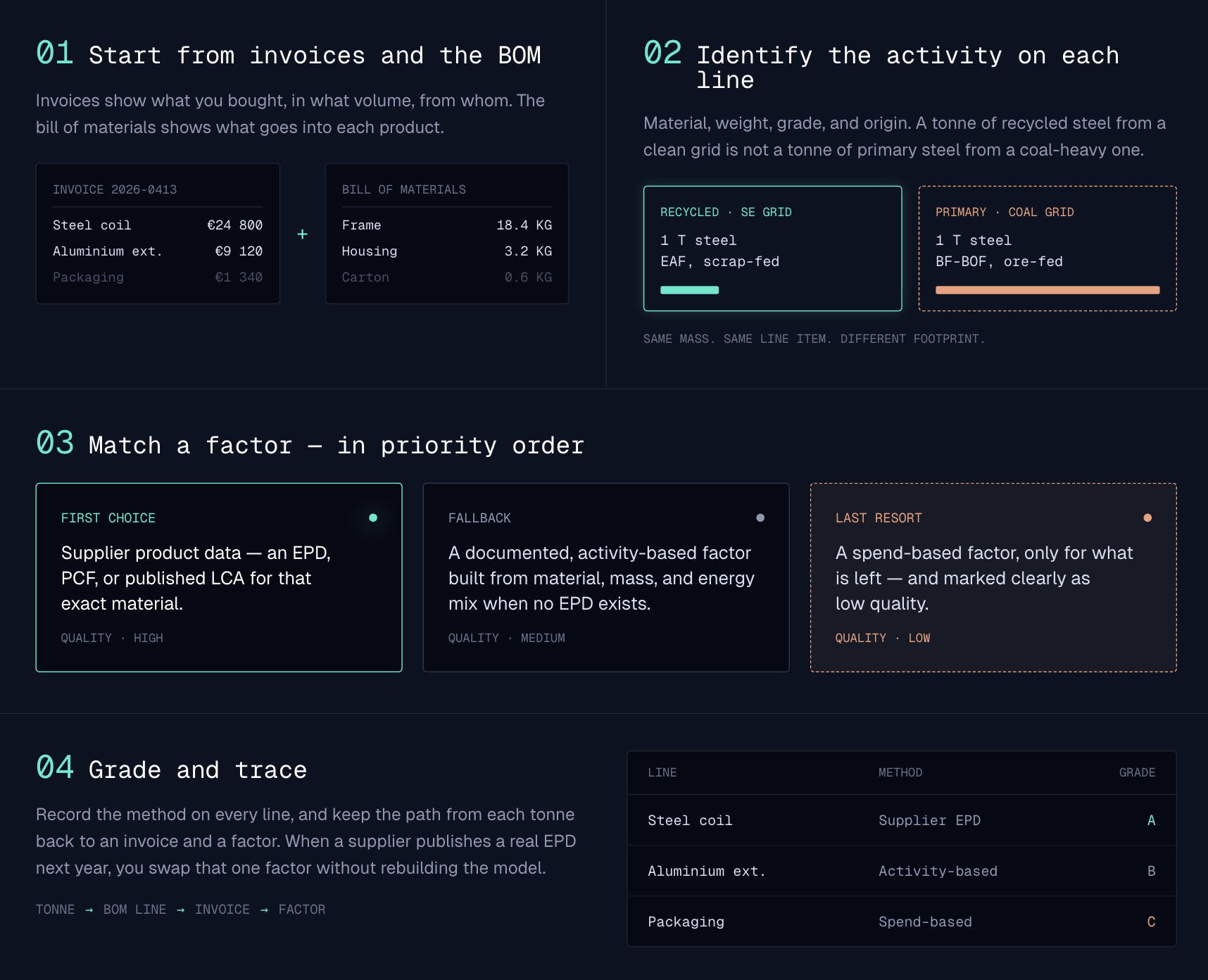
Invoices + bill of materials → material, mass, grade and origin → factor in priority order (supplier EPD > documented activity-based factor > spend-based, marked low quality) → method recorded and traceable from each tonne back to invoice and factor.
Do this and you get two things at once: an auditable Scope 3 number, and a product carbon footprint you can hand to a customer.
05 - MISTAKES
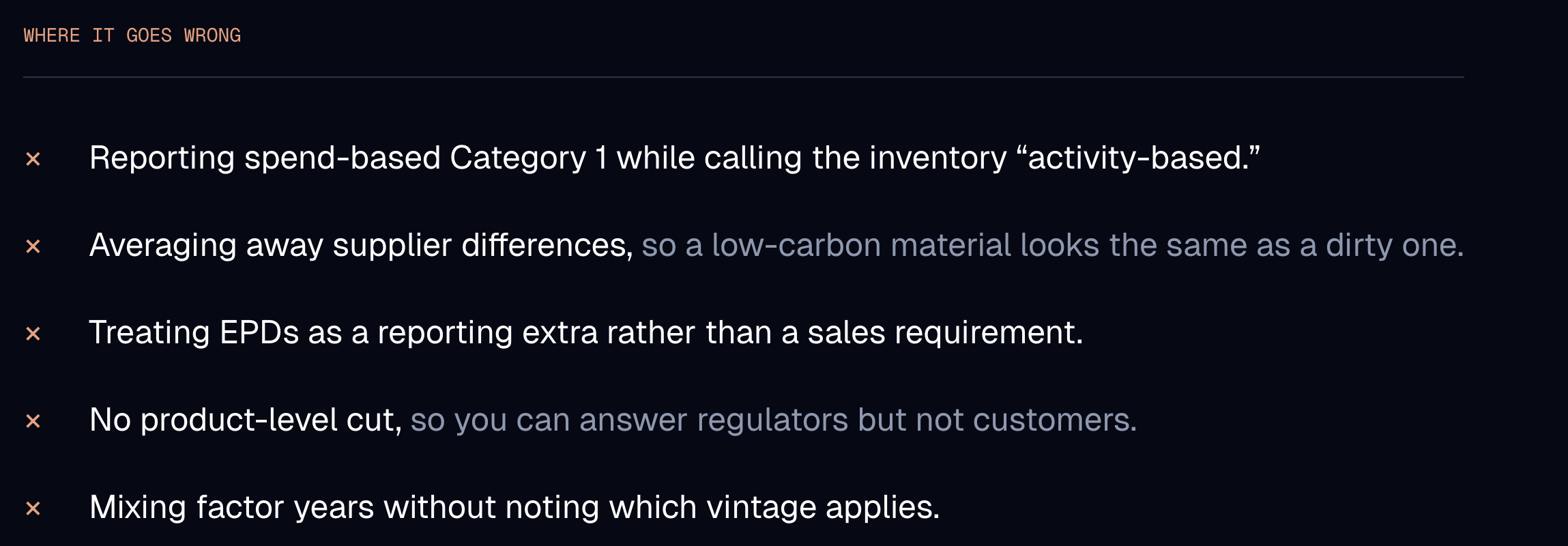
Common Manufacturing Carbon Accounting Mistakes
Standards & references: GHG Protocol Corporate Standard, GHG Protocol Scope 3 Standard, GHG Protocol Product Standard, ISO 14067 (product carbon footprint), WBCSD PACT Pathfinder Framework
Frequently Asked Questions
.svg)
For most manufacturers it is Category 1, purchased goods and services: the raw materials, components, and packaging you buy. It usually outweighs your own factory emissions (Scope 1 and 2) by a wide margin.
Build it from the product's bill of materials. Take each material by weight and origin, match it to the best available emission factor with supplier product data first, and add the energy used to make and move it. Keep every step traceable to a document.
As a floor, yes, but not for the parts that matter. Spend cannot tell two suppliers of the same material apart, and it cannot produce a product-level number for a customer. Use supplier product data or an activity-based factor for your high-impact purchases.
An Environmental Product Declaration is a verified report of a product's environmental impact, based on a life cycle assessment. More customers and procurement rules now ask for one, so for many manufacturers it has become a business requirement rather than an extra.
They push hard toward it. CBAM prices the embedded carbon of certain imported goods, CSRD and ESRS E1 ask you to disclose how much of your Scope 3 is primary rather than estimated data, and the EU Digital Product Passport will carry product data from 2027. Spend-based estimates do not meet that bar.


Try for yourself
See what we'd find in your data.
We'll analyze a sample of your invoices and show you what real carbon data looks like for your organization.
See it in action
 Talk to our team
.svg)