

.jpeg)
ARTICLE

AI in Scope 3: How to Calculate the Carbon Footprint of AI Tools | Bardo
Buying AI tools creates emissions. For almost every company, those emissions land in Scope 3, Category 1 (purchased goods and services), the same bucket as the rest of what you buy. The part that counts as yours is the AI you use, not the training of the model.
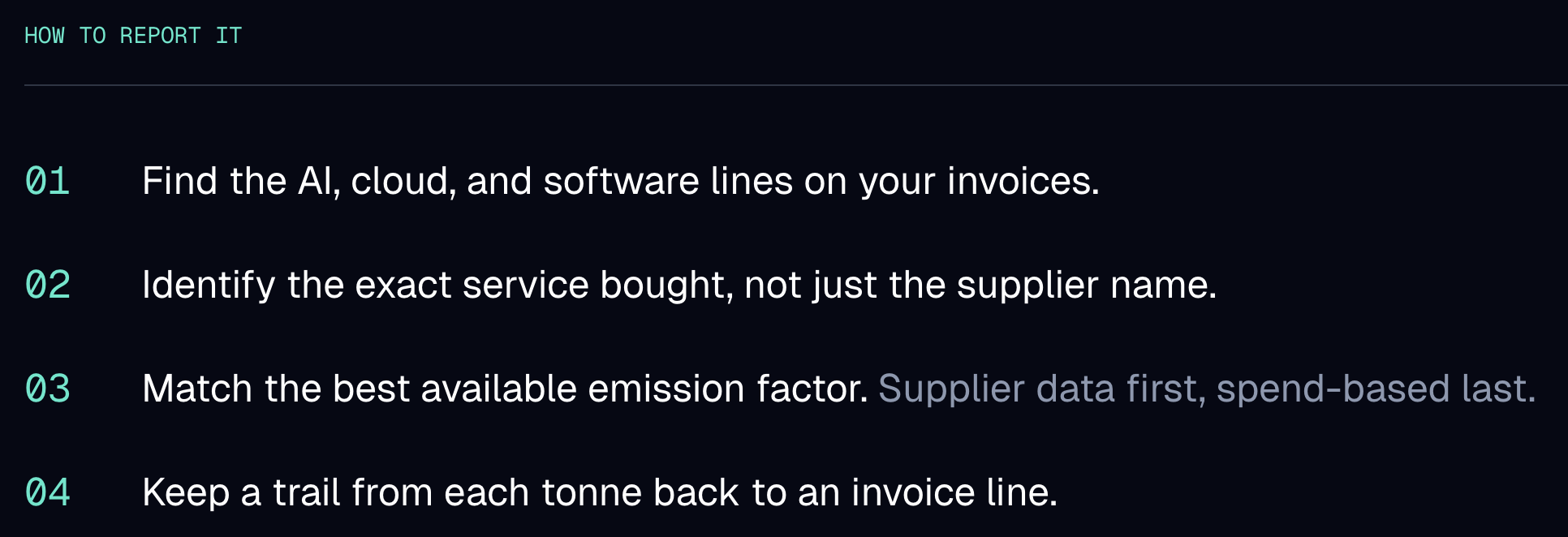 The same steps work for cloud and other IT services. Here is what belongs where, and how to build a number that survives an audit.
01 - EXPLANATION
What Scope Are AI Emissions?
When you buy AI as a service, you do not run the servers. Your provider does. So the emissions are indirect, and they sit in your Scope 3. The right home is Category 1: purchased goods and services.
Two points that trip teams up:
Training is not yours. A large model is trained once, by the model developer. As a buyer, the footprint that belongs to you is inference: the emissions from running your prompts and queries. Report inference, not training.
The same logic covers cloud and SaaS. Move your computing to the cloud and what used to be your Scope 1 and 2 becomes your Scope 3. Cloud, SaaS, and AI tools are all purchased digital services, and for the buyer they are Category 1.
02 - FAILURE MODE
Why Spend-Based Falls Short for AI and Cloud
The default advice everywhere is the same. No supplier data? Multiply your spend by an industry average factor and move on.
That is a floor, not an answer. Two AI subscriptions at the same price can have very different real footprints, depending on the model, the region, and how heavily you use them. A spend number cannot see any of that. And when your provider switches to greener power, a spend-based figure does not move, so it cannot show a real reduction or survive a serious audit question.
03 - PROVIDER TOOLS
Do Cloud Carbon Dashboards Solve it?
The big providers publish dashboards. Azure, Google Cloud, and AWS all show emissions from your usage. They are useful, but they leave a gap.
They report the provider's own Scope 1 and 2 from your usage, which is not the same as a clean, traceable line in your Category 1 inventory. They cover only that provider, so the many smaller SaaS and AI tools on your normal invoices are left out. The dashboard sits in one place. Your invoices sit in another.
04 - THE METHOD
How to Calculate AI and Cloud Emissions from Invoices
The invoice is the one place that already lists every digital service you pay for. Start there.
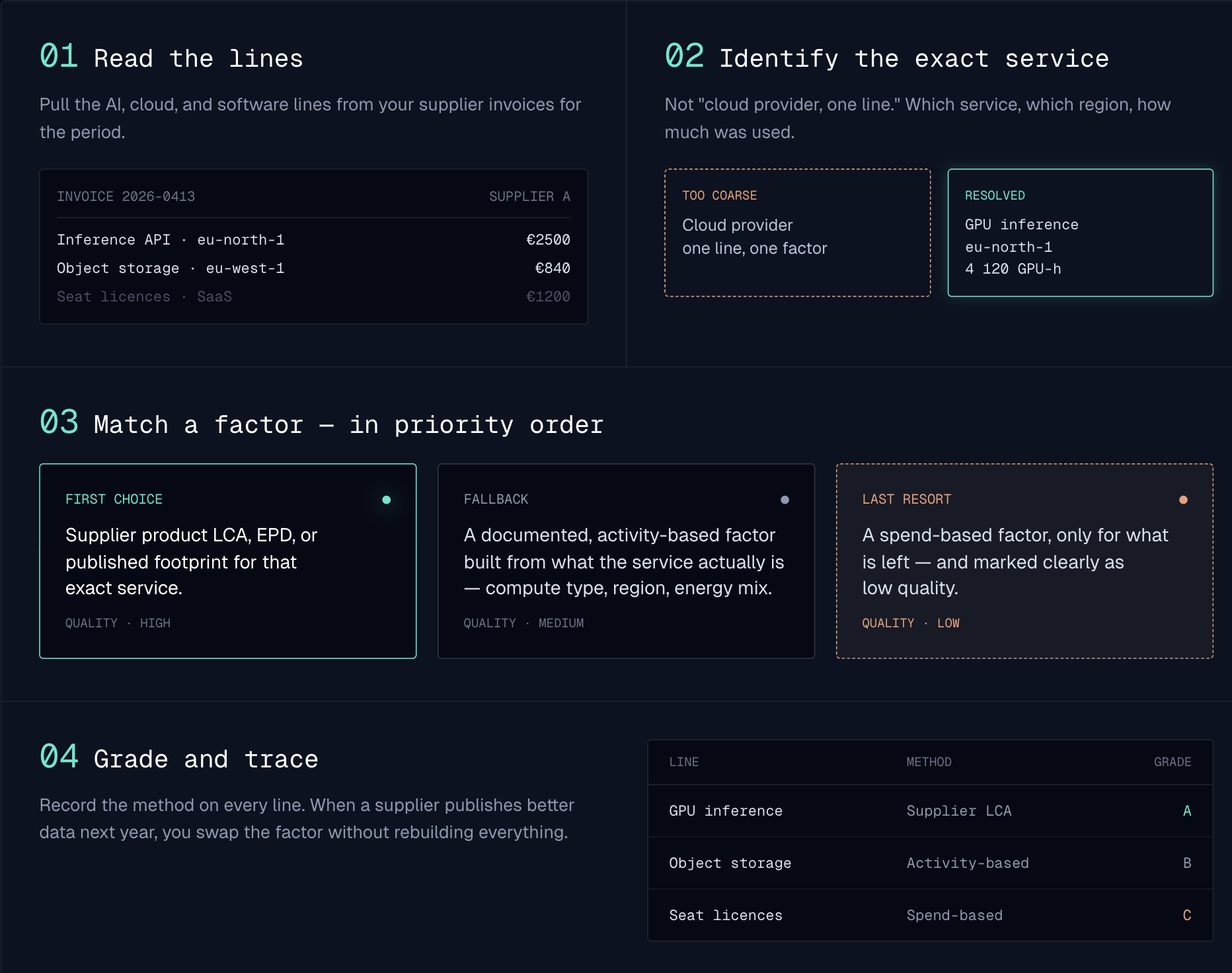
The activity-based method: invoice line → exact service → factor in priority order (supplier LCA > documented activity-based factor > spend-based, marked low quality) → method recorded and graded per line.
Break emissions down to the service level and you can compare suppliers by intensity, spot the heavy tools, and switch to lighter options where it matters. That is the difference between a number you file and a number you can act on.
05 - MISTAKES
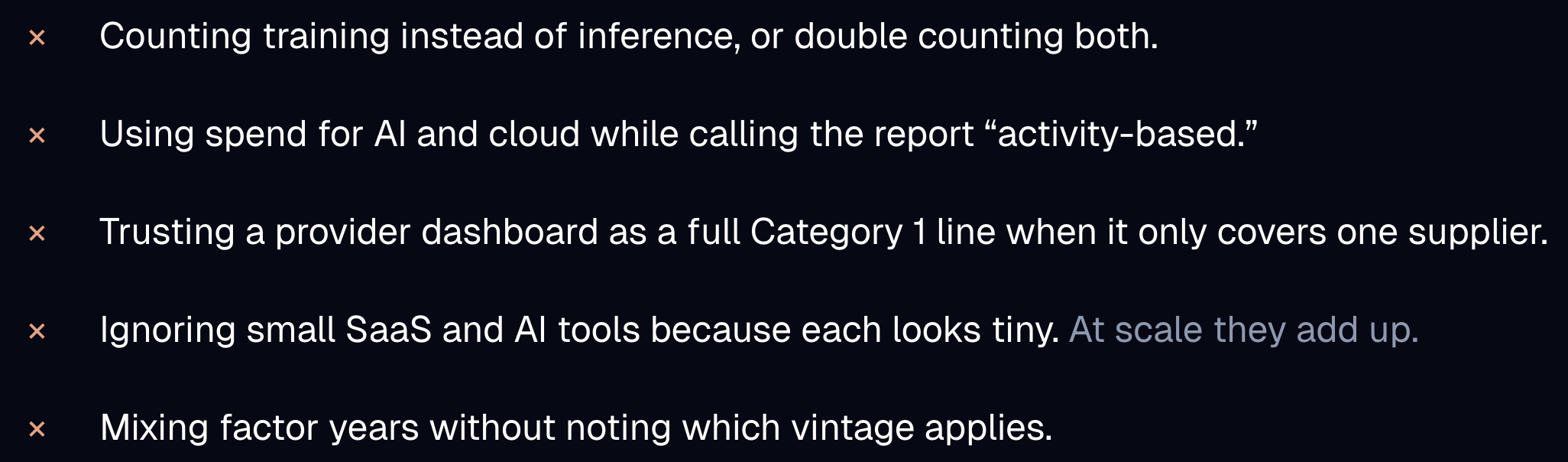
Common AI and Cloud Carbon Accounting Mistakes
Standards & references: GHG Protocol Corporate Standard, GHG Protocol Scope 3 Standard, GHG Protocol Technical Guidance for Calculating Scope 3 Emissions, ISO 14067 (product carbon footprint)
Frequently Asked Questions
.svg)
For a company that buys AI as a service, they are Scope 3, Category 1 (purchased goods and services). You do not own the servers, so the emissions are indirect. If you run your own AI hardware, the electricity is Scope 2 and the hardware manufacturing is Scope 3.
Not directly. Training is run once by the model developer and sits mainly in their own footprint. What you report as a buyer is your use of the service, its inference, driven by how much you run it.
Start from the cloud lines on your invoices, identify the exact services and regions used, and match each to the best available emission factor. Use supplier-specific data first and a spend-based factor only as a marked last resort.
It helps, but you are not stuck without it. When a provider gives no usable data, an activity-based factor can be built from what the service is and where it runs, with the calculation traceable back to the invoice line.
For many service and software companies it is. Under CSRD and ESRS E1 you report Scope 3 where material, with transparent methods. For SBTi progress, spend-based cloud figures often cannot show real cuts, so activity-based data is the stronger base.


Try for yourself
See what we'd find in your data.
We'll analyze a sample of your invoices and show you what real carbon data looks like for your organization.
See it in action
 Talk to our team
.svg)